 SkyyCast
A single decent blog post usually contains enough raw material for a week of social posts, and most of it never gets used. The post goes out once as a link, maybe with a summary line, and the twenty quotable sentences, the one surprising figure, the counter-argument buried in the sixth paragraph — all of it stays inside an article most of your audience will never open. Repurposing is the habit of mining what you've already made before you make something new. Done on purpose, it's the difference between posting consistently and running dry in a month.
The idea behind it
The formal name is COPE, "create once, publish everywhere" — a phrase NPR's team coined in 2009 to describe building a piece of content once and letting every channel draw from it. For a newsroom that meant a content system and an API. For one person running a few accounts it means something simpler: treat every substantial thing you make — a blog post, a podcast episode, a conference talk, a long video, a customer call you're cleared to quote — as a source rather than a single post. The source gets published in its native form once. The social posts are extracts from it, each shaped for where it runs.
The version of "repurposing" that gives it a bad name is posting the same paragraph to five platforms. That isn't repurposing, it's duplication, and audiences and ranking systems both treat it that way. The useful kind takes one idea from the source and rebuilds it for each place it appears.
What to pull out of a source
Go through the piece once with a highlighter mindset and mark anything that could stand on its own:
- A claim or takeaway. The one-sentence version of your argument, often your headline rewritten as a statement rather than a question.
- A number or fact that made you stop when you first came across it. One concrete figure travels further than a general point.
- A step or a list. Any "how to" section is already a carousel, a thread, or a short video script.
- A quote. Yours, a source's, or a customer's. Attributed quotes get shared because they're easy to agree or disagree with.
- A contrarian moment. The "most people assume X, but actually Y" beat. In practice this is usually the best-performing extract you have.
- A mistake or a lesson. What you got wrong before you understood the topic. People trust these more than advice delivered from on high.
- A visual. A chart, a before-and-after, a screenshot, a diagram. Even a plain quote card counts.
- A question the piece answers. Posted as a question, held open for a while before you reply, it invites responses instead of just impressions.
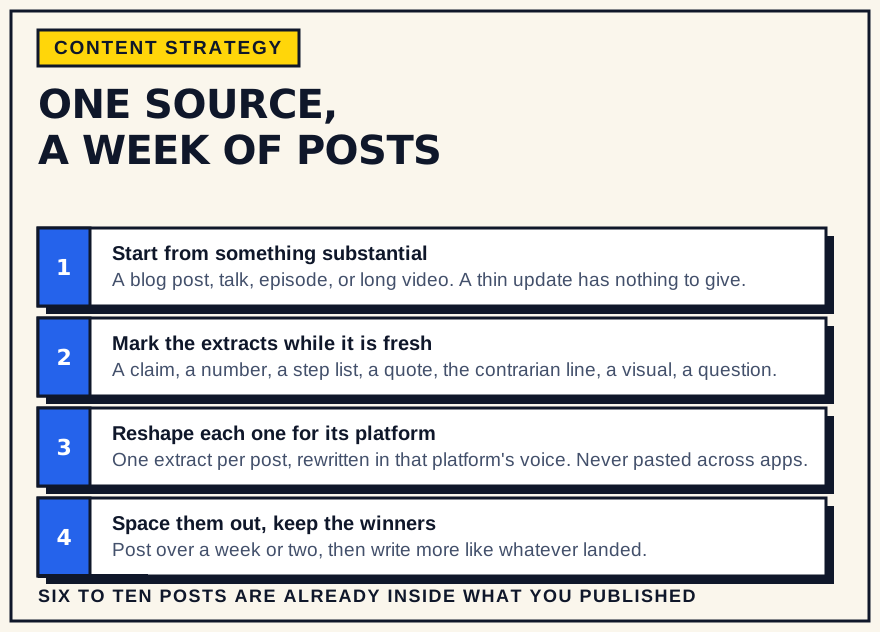
A 1,200-word post reliably yields six to ten of these. That's already two weeks of posting at a normal cadence, out of an afternoon of writing you'd done anyway.
Adapt each extract to the platform
Same point, different clothing. The goal is that no post reads like a sentence lifted from an article, because that's exactly how it will land if you don't rework it. A few concrete moves:
- Text-first networks — Bluesky, X, Threads, LinkedIn. Lead with the claim or the number; the first line is effectively the whole post in the feed and the rest may be hidden. Use a thread only when the source has genuinely sequential steps to walk through.
- Image-first networks — Instagram, Pinterest. The extract becomes the image: a quote card, a titled list, a single-chart graphic. The caption carries the context the image can't.
- Short video — Reels, TikTok, Shorts. One extract per video, said out loud in fifteen to forty seconds, with the text on screen for anyone watching muted.
- Long video and email — these can hold a fuller version: two or three extracts stitched into one segment or section.
Two rules of thumb hold across all of them. One extract per post, so each has a single clear point. And rewrite it in the platform's own voice instead of pasting — if you can tell which article a caption came from, it needs another pass.
A worked example
Say you gave a ten-minute talk on pricing for freelancers. Working from the transcript, you can pull: the core argument — "charge for the outcome, not the hour" — as a standalone post; the moment a client agreed to double your rate without hesitating, told as a short story; the three-question script you use to set a price, as a carousel; the "I undercharged for four years" admission as a lesson post; a twenty-second clip of the closing line for Reels; the slide showing your pricing ladder as an image post; and "what's the first thing you'd raise your rate on?" as a question to your audience.
That's seven posts across three formats from one talk, and each of them gives someone a reason to go watch the full thing without being a bare link that says "new talk, check it out."
Where it goes wrong
- Copy-paste across platforms. The fastest way to make repurposing look automated and get treated as spam.
- Repurposing a thin source. If the original was 300 words with one idea, there's nothing to extract. This habit multiplies substance; it can't manufacture it.
- Every post a teaser. If nothing you post is useful unless someone clicks through, the account becomes a billboard and people stop clicking. Most extracts should stand on their own whether or not anyone follows the link.
- Working from memory. "I'll remember the good parts" means you'll reuse the same two. Mark the extracts in the document while the source is still fresh in your head.
- Never checking what landed. The reason to get many small posts out of one source is that you learn which framing works, then write more like it. Skip that step and you've just made more posts.
Make it a step, not a project
The habit that makes this stick is a single line added to your publishing routine. Before a substantial piece goes out, spend ten minutes pulling extracts into your idea bank or a running doc, each one tagged with the content pillar it belongs to. Then they're already waiting when you sit down to plan the week. One of these moves — turning a whole structured article into a sequential thread — is worth its own process when the source lends itself to it.
Bottom line
You're almost certainly sitting on more content than you think. Every substantial thing you publish is a source with six to ten posts in it, and each one needs reshaping for its platform rather than copying. Pull the extracts while the work is fresh, adapt them natively, space them out over a week or two, and keep the ones that worked. It's the cheapest content you'll ever make, because you already made it.