 SkyyCast
“I have nothing to post today” is almost never a shortage of ideas. It is ideas you had and did not write down — in the shower, on a walk, halfway through something else — that were gone by the time you sat down to post. A content idea bank fixes that: one place ideas go the moment you have them, plus just enough structure that future-you can actually use them. Here is how to build one you will keep using.
Why ideas disappear
You get ideas at inconvenient moments and lose them to the next thing that grabs your attention. By the time you open the composer, the feeling that made the idea interesting has faded, and you are starting from zero. The bottleneck is not creativity or discipline; it is capture. Solve capture and the blank-page problem mostly goes away.
Pick one place, and make it frictionless
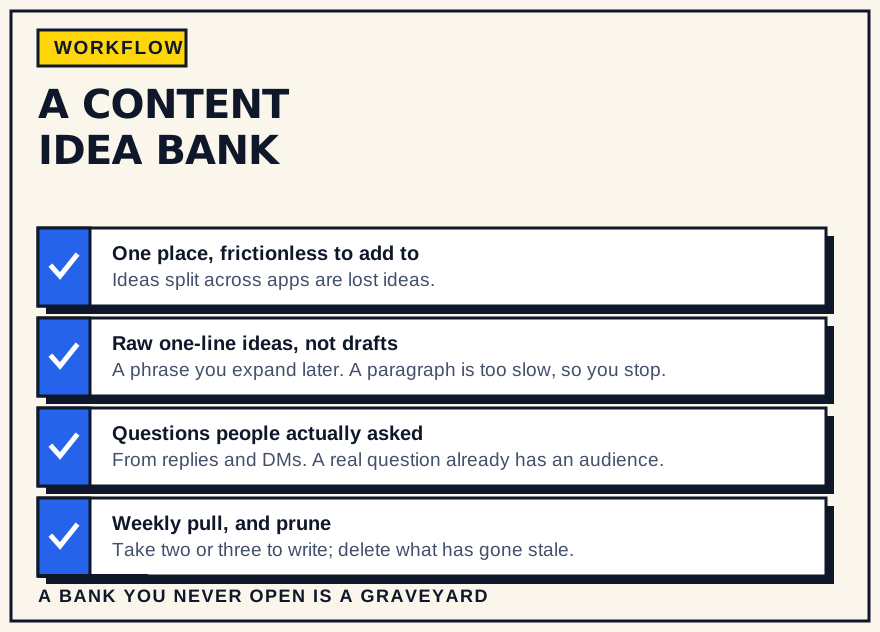
Use one tool, not five. A notes app, a single spreadsheet, a Notion or Airtable table — whatever you will actually open in a few seconds on your phone. The test is simple: can you add an idea in under ten seconds without thinking about formatting? If not, the setup is too heavy. Ideas scattered across three apps and a camera roll are the same as no ideas.
If your tool has a phone widget or a share-sheet shortcut, use it — the goal is to capture an idea without unlocking your full attention. The moment it feels like a task, the habit breaks.
What to put in it
More than a list of topics:
- Raw ideas, one line each. Not drafts. A phrase you can expand later is enough; a paragraph is too slow to write, and you will stop.
- A swipe file. Posts, threads, and articles that worked — yours and other people's — saved with a note on why: the hook, the structure, the angle. A swipe file is a gallery of good work to borrow structure from, not to copy.
Saving is mechanical: bookmark the post, screenshot it, or paste the link into one folder in your bank. The note matters more than the item — “strong first line, names the reader's mistake” is what you will use later, not the post itself.
- Questions people actually asked. From replies, DMs, and comments. A real question is a post that already has an audience.
- Anything you have explained twice. If you have said it to two different people, it is a post.
- Offcuts. The point you cut from a longer piece for length is often its own idea.
- Angles, not just topics. “Bluesky feeds” is a topic. “The mistake people make setting up their first feed” is an angle — and angles are what you can actually write.
A quick way to turn a topic into an angle: finish one of these about it — “the mistake most people make with…”, “what I got wrong about…”, “the fastest way to…”, “X versus Y, and when each one wins”, “what changed my mind about…”. Each finished sentence is a post.
What an entry looks like
A usable entry is short and specific: “Angle — people set their first custom feed too broad, one keyword, thousands of junk posts; fix is to start narrow. Pillar: feeds. Status: raw.” A weak entry is just “custom feeds” — true, but it does none of the work. The rule of thumb: an entry should let you start writing without having to work out what the point is again.
A little structure, not a lot
Two fields are enough. Tag each idea with one of your content pillars — the three to five themes you post about — so you can pull ideas for a specific lane when you need them. And give each a status: raw, ready, or used. Resist impact scores, effort ratings, and elaborate templates. Every extra field is friction, and friction is what kills these systems.
The weekly pull
Once a week, move three to five raw ideas to “ready.” Turning each one from a topic into a specific angle plus a first line is the actual thinking; do it in a batch, not at posting time. Those ready ideas feed your calendar or your posting queue for the week. This is also when you prune — delete ideas that no longer interest you. A shorter bank you trust beats a huge one you avoid opening.
Aim to keep roughly two to four weeks of “ready” ideas ahead of you. Much less and you are back to scrambling; much more and you are polishing ideas you may never use while the raw pile goes stale.
Feeding the bank on purpose
Left alone, a bank runs dry. Once a week, spend fifteen minutes topping it up: skim your best-performing past posts for things worth revisiting, look through your swipe file, reread the replies and DMs from the week, and check one or two sources in your niche. Add ten new lines. Useful recurring prompts: a question people asked this week, something you changed your mind about, a step others skip, a comparison between two options, a short story from doing the work. That is roughly a month of raw material for a quarter of an hour.
Common ways it fails
- Too many places. Ideas split across apps are lost ideas. One home, always.
- Capturing drafts instead of lines. If adding an idea takes real writing, you will skip it exactly when it matters.
- Never pruning. An un-weeded bank becomes a graveyard, and opening a graveyard feels bad, so you stop.
- Over-structuring. When filling in the fields becomes the task, the writing does not happen.
- Topics without angles. A list of subjects still leaves you staring at the composer. Store the angle.
The bottom line
An idea bank is two habits in one trusted place: capture ideas the second you have them, and spend fifteen minutes a week sorting and refilling. Keep it small and current. Do that and the daily question stops being “what do I post” and becomes “which of these do I post” — which is the difference between a blank screen and posting consistently without dreading it.