 SkyyCast
Content pillars are the three to five themes you commit to posting about. Most guides stop there and hand you a list. The part that actually matters is the opposite of a list: pillars are a decision about what you will stop posting. A set that holds up makes some posts obviously off-topic for your account, so you do not make them. It is the least glamorous part of a content plan and the part that does the most work — here is how to pick one.
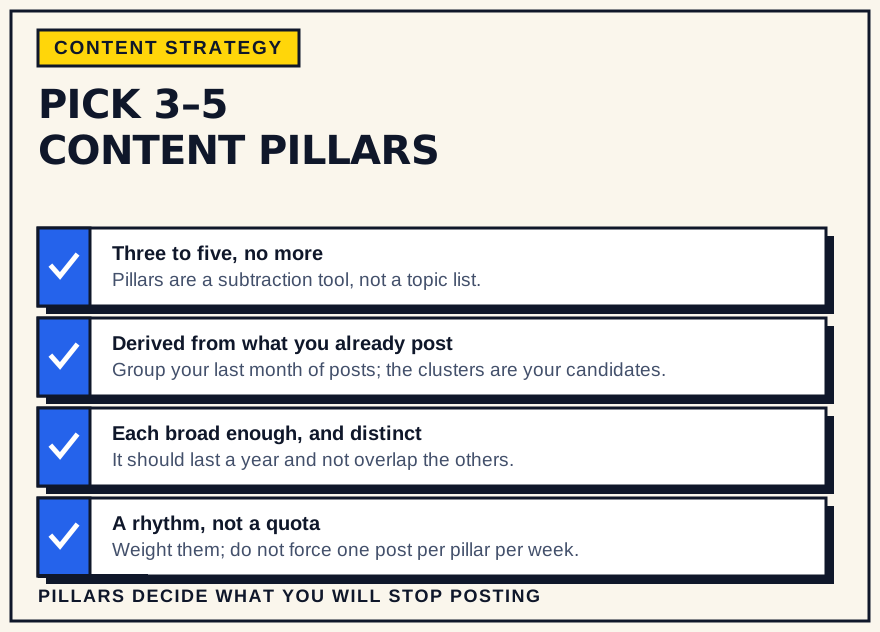
Pillars are a subtraction tool
The common mistake is treating pillars as “topics I am allowed to cover” and choosing them broadly so nothing is ruled out. That defeats the purpose. A pillar set is a promise about what your account is for, and its value is the friction it adds to everything outside that promise. If your pillars do not make you hesitate before posting something, they are too loose to be doing anything.
Derive them from what you already post
Do not invent pillars from a blank page — you will describe who you want to be, not what you actually publish, and then drift back. Instead, look at your last thirty or so posts, plus the handful you wish you had made. A quick way to cluster: write each post's topic on a line, then draw brackets around the lines that belong together. Four or five brackets usually emerge. The clusters that are frequent, that tend to get a response, and that you would happily make more of are your candidates; anything outside the brackets is a one-off, which is exactly the noise the pillars are meant to cut.
Test each candidate three ways
- Breadth. Set a timer for ten minutes and list specific post angles under the candidate. Twenty or more and it has legs. Three and then a stall means it is too narrow — it will run dry in a week. If the list turns into an unrelated grab bag, it is too broad to make you recognisable.
- Difference. Would this exact pillar be true of ten other accounts in your space? “Marketing” would. “Marketing for solo founders with no ad budget” would not. Sharpen a generic pillar until it points at you specifically.
- Sustainability. Can you make this content on a normal week, without waiting to feel inspired? A theme you can only execute on a good day is not a pillar; it is an occasional post.
A worked example
Say you run a small pottery studio and post about: new pieces, a kiln that broke, a glaze test, a customer's kitchen, a rant about shipping costs, a studio-tour photo, a technique tip, a local craft fair, a piece that failed. Grouped, that is finished work, process and experiments, the business of running the studio, and the local scene. Tested: “process” yields thirty angles; “local scene” yields four, so it becomes an occasional post rather than a pillar. The final set is finished work, process, and running-the-studio, with a light personal thread. The shipping rant still gets posted — it just is not a pillar.
How many
Three to five is the widely recommended range — a convention, not a rule. Fewer than three and the account feels repetitive; more than five and it reads as several unrelated accounts sharing a login. If you have landed on seven candidates, some are sub-topics of others; merge them. A workable shape is one core pillar you want to be known for, two or three adjacent ones, and optionally one personal or behind-the-scenes thread. Adjacent means still recognisably your subject: a running coach's core pillar is training, and “race-day logistics” or “recovery” widen it without becoming a different account.
Turn pillars into a rhythm, not a quota
Resist assigning rigid percentages — “40% education, 30% community” schemes collapse the first busy week. A loose weighting is enough: the core pillar most weeks, the others rotating through. Pillars are a tag on your ideas and a lens for your calendar, not the schedule itself. Their job in a posting routine is to make the weekly question “which pillar today, and what angle” instead of “what on earth do I post.”
Pillars are the spine, not a cage. A timely reaction, a one-off, a personal update — those still belong on the account occasionally. The pillars just make sure the bulk of what you post adds up to something, so the occasional detour reads as range rather than drift.
Common failure modes
- Pillars that are really formats. “Educational, entertaining, promotional” is a tone taxonomy, not a set of topics. Pillars are about subject; how you deliver each one is a separate choice.
- Aspirational pillars. If the set describes the account you intend to become rather than the one you run, you will keep posting off it. Match the pillars to reality, then move reality if you want to.
- “Just in case” pillars. Every extra pillar added so you are not boxed in dilutes what people can associate with you. Three sharp ones beat six safe ones.
- Set and forget. Pillars should shift when your focus genuinely does. A check once a year is enough; more often and you are just churning.
Bottom line
Good pillars make it obvious what to post and, more usefully, what to skip. Pull three to five from what you already publish, test each for breadth, difference, and whether you can keep it up, weight them loosely, and look at the set again once a year. The point is not the themes on the page; it is the posts you no longer waste time making.