 SkyyCast
“How often should I post?” is one of the first questions people bring to a new platform, and on Bluesky it does not have a tidy answer. Bluesky has never published guidance on posting frequency, and there is no large public study of how cadence affects reach or growth there. What you can do is reason from how the platform is built, look at what steady accounts actually do, and then test a rhythm you can sustain. This guide walks through all three.
Why there is no official number
No one at Bluesky has said “post this many times a day,” and the app does not surface a recommended cadence anywhere. Analytics companies publish frequency tips, but those are compiled from their own client data, not from Bluesky, and they disagree with each other — some suggest one to three posts a day, others four or five. Buffer, which analysed more than 52 million posts across networks for its 2026 engagement report, put it plainly: “There's no magic number, and consistency matters more than volume.”
That is the honest starting point. The useful follow-up question is not “what is the number” but “what does Bluesky's design reward, and what can I keep up?”
What Bluesky's design implies
Bluesky's default Following feed is reverse-chronological. Every post from the accounts someone follows appears in order, with nothing ranked up or buried. There is no central engagement algorithm deciding whether your third post of the day “deserves” to be shown. Discovery through custom feeds and the Discover feed is a separate layer, and it rewards engagement on individual posts rather than how many you publish.
For that discovery layer, cadence matters only indirectly. A niche feed can surface a post you have actually published recently, so an account that posts most days gives those feeds more chances to catch something. That is an argument for regularity, not for volume: three thoughtful posts a week, every week, does more than a burst of twenty followed by silence.
Two things follow. There is no algorithmic penalty for posting often — a fourth post will not suppress your earlier three. And there is no algorithmic bonus for hitting a magic frequency either. The real cost of over-posting is social: followers who feel flooded can mute or unfollow, and neither of those shows up in your notifications.
The technical ceiling sits far above anything a person would reach. Bluesky's rate-limit documentation uses a points system in which creating a record costs three points, which works out to roughly 1,600 posts an hour; Bluesky says the limits exist for bots and “shouldn't affect typical users.” The platform is not trying to hold your volume down. The constraint is entirely on your side — attention, ideas, and time.
A reasonable starting point
With that context, here is a sensible default to work from — drawn from what active accounts tend to do, not from any Bluesky rule:
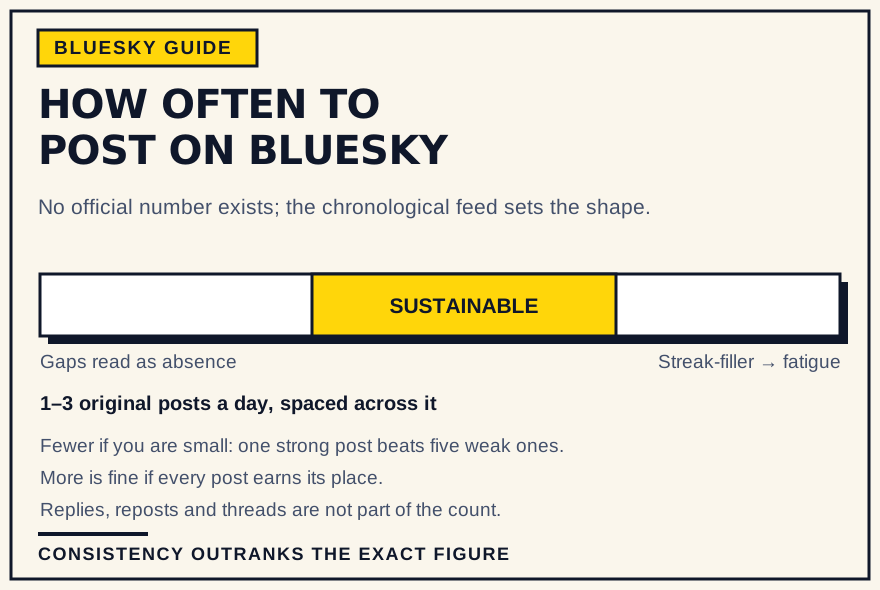
- One to three original posts a day, spaced out. Enough to stay present in a chronological feed without dominating it. Spreading them across the day beats publishing them in a single block.
- Fewer if you are small. Under roughly a thousand followers, one strong post a day usually beats five weak ones. With a small audience, extra posts mostly divide the same limited attention across more items, so nothing gains traction.
- More is fine if you have the material. News accounts, live-posters, and people in active conversations post well past three times a day without trouble, because each post earns its place. A useful test: if you would still send the post with no streak to keep, it belongs; if not, it is filler.
- Replies and reposts are not part of the count. They do not read as flooding the way back-to-back original posts do, and they keep you visible between posts. Threads work similarly, letting you develop one longer idea as a single unit instead of five loose posts.
- Consistency outranks the exact figure. The same three or four posts every week are worth more than ten one week and none the next. A chronological feed has no memory, so gaps simply read as absence.
Signs your cadence is off
Rather than chase a target, watch for the symptoms of posting too much or too little.
- Too much: your median engagement per post falls while nothing else has changed; you notice mutes or a stalling follower count; you catch yourself posting things you would not have bothered with a month ago, just to keep a streak going.
- Too little: people reply as if surprised you are still active; you have nothing recent for niche feeds or the Discover feed to pick up; every return feels like starting over because the last post was two weeks ago.
How to find your own number
Treat it as a short experiment. Pick a floor you can hit every week without straining — five posts a week is a fine place to start — and hold exactly that for three to four weeks. Judge it on your median post, not your best one, and on whether your follower count trends up, flat, or down. Then change one thing at a time: add a post a day, or shift when you post, and give it another few weeks. A repeatable posting workflow and scheduling posts in advance make that floor realistic, which is the point: a cadence you can actually keep beats an ambitious one you abandon after nine days.
Keep the measurement crude on purpose. A note of your weekly post count and your rough median likes or replies is enough to see a trend. You do not need a dashboard, and fixating on per-post numbers tends to push people back toward posting for the metric instead of the reader.
The bottom line
There is no official answer because Bluesky's design does not need one: the Following feed shows everything, the rate limits are irrelevant to humans, and discovery rewards good individual posts rather than raw output. One solid post a day is a defensible default. Beyond that, the right frequency is simply the highest one you can sustain without padding — and it is better found by testing your own account for a month than by copying a number off a list.