 SkyyCast
When someone lands on your Bluesky profile, they decide whether to follow in a few seconds, using four things: your display name, your avatar, your bio, and the first post or two they can see. A profile worth following makes one thing obvious in that glance — who you are and what you post about — and does not contradict itself. None of this is a ranking trick. Bluesky does not rank accounts by profile quality; a good profile simply converts the visitors you already get. Here is how to tighten each part.
Make your identity immediately clear
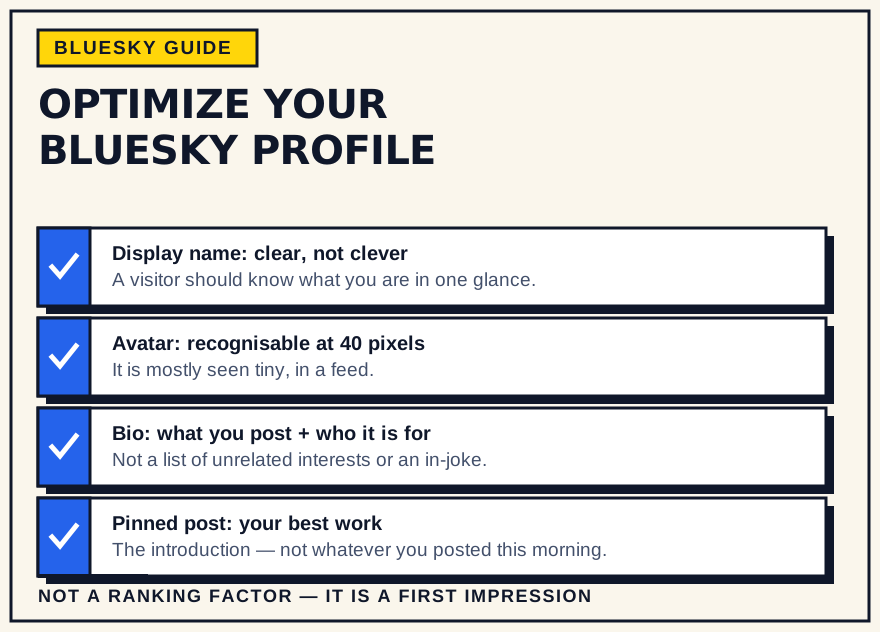
The top of your profile is a headline, not a place for cleverness that needs decoding. Between your display name and the first line of your bio, a stranger should be able to finish the sentence “this account is about ___.” If your display name is a pun and your bio opens with a joke, you have spent your clearest space on something a visitor cannot act on. Lead with the plain version; keep personality for further down.
Write a useful bio
Bluesky currently gives you a short display name (around 64 characters) and a bio of around 256, counted as graphemes, so emoji and accented characters eat into that. You edit both, plus your avatar and banner, from Edit Profile. Use the bio to answer three things in order: what you post about, who you are or why you are worth listening to, and where to go next — a link, a newsletter, a site. URLs in the bio become clickable, so one or two short links fit.
Naming your topic in plain words has a second, smaller benefit: it helps you turn up when someone searches Bluesky for people in that area. That is findability, not a reach boost — it does not change how your posts are distributed — but it is a reason to write “urban planning and transit policy” rather than “thoughts & things.”
Choose a recognizable profile picture
Bluesky shows your avatar as a small circle almost everywhere — in replies, in feeds, in notifications — and full size only when someone opens your profile. Pick an image that still reads at thumbnail size: a clear headshot, a simple logo, or a distinctive illustrated avatar, with the subject centred so the circular crop does not clip it. Group photos, wide landscapes, and busy images all fail the thumbnail test. Once you pick one, keep it — people recognise you by it in the timeline.
Use the banner intentionally
The banner is a wide strip behind the top of your profile, roughly 3:1, with your avatar overlapping the lower-left corner and the sides cropping tighter on mobile. Keep anything important — text, a face, a logo — in the middle. A banner does not have to say anything; a plain colour or texture that matches your avatar is fine. What it should not do is contradict the rest of the profile with unrelated stock imagery.
Choose the right handle
Your default handle is a .bsky.social address. You can replace it with a domain you own — @yourname.com — by adding a DNS record. Bluesky describes this as identity and verification: a domain handle “borrows the authority” of a website and shows the same person is behind both, and it carries across other apps built on the same protocol. What it does not do is increase your followers or reach on its own — treat it as a credibility and consistency choice, not a growth tactic. If you do not own a relevant domain, a clear .bsky.social handle is completely fine. There is still no dedicated multi-link field on profiles — that is an open feature request — so extra links live in your bio or your pinned post.
Use the pinned post as your introduction
You can pin one post to the top of your profile. It is the one piece of your actual content a visitor is guaranteed to see, so use it as a deliberate introduction rather than leaving whatever you posted this morning there. Good choices: a short “what I post here” note, your best or most representative piece, or a link to the thing you most want people to find. It is not an algorithmic signal — it changes nothing about distribution — it just controls the first impression. Refresh it when it goes stale.
Make your profile match what you actually post
The most common reason a visitor does not follow is a mismatch: the bio promises one thing and the recent posts are about something else, or the account has not posted in weeks. A profile is a promise about the timeline behind it. If your bio says you cover a topic, your last ten or fifteen posts should mostly be recognisable as that topic — which is easier if you post with a consistent focus and plan your posts rather than improvise daily. If your interests have genuinely shifted, update the bio to match; do not leave the old promise up.
Recency matters here too. A visitor checks whether the account is alive; long gaps read as abandoned, so showing up regularly is part of the profile even though it is not on the profile.
A 5-minute Bluesky profile audit
Open your own profile the way a logged-out visitor would see it and check:
- Glance test. In three seconds, can a stranger say what you post about? If not, fix the display name and first bio line.
- Avatar. Does it read as a tiny circle? Open a reply thread and look at it there.
- Bio. Topic, then credibility, then a link — in that order, no filler.
- Pinned post. Is one pinned, is it current, and is it the thing you most want seen?
- Recent feed. Do the last ten posts match the bio's promise? Is the most recent one actually recent?
- Links. Do the bio links work and point where you intend?
Common profile mistakes
- A witty display name with no plain meaning. Fine as a second layer, bad as the only signal.
- A bio that lists moods, not topics. “Coffee. Chaos. Vibes.” tells a visitor nothing to follow for.
- An avatar that only works large. If it is unreadable in a thread, it is the wrong image.
- No pinned post, or one from a year ago that no longer represents you.
- A profile that outran the posts. The bio describes who you planned to be, not what the timeline shows.
- Treating the custom domain as the win. It helps credibility; it does not do the work of a clear bio and a live feed.
Bottom line
A Bluesky profile is not ranked, so optimising it is not about pleasing an algorithm — it is about making a fast, honest case to the people who already clicked. Name your topic plainly at the top, use an avatar that survives a thumbnail, point the pinned post at your best work, and make sure the recent feed backs up whatever the bio claims. Run the five-minute audit now, and again whenever what you post changes.