 SkyyCast
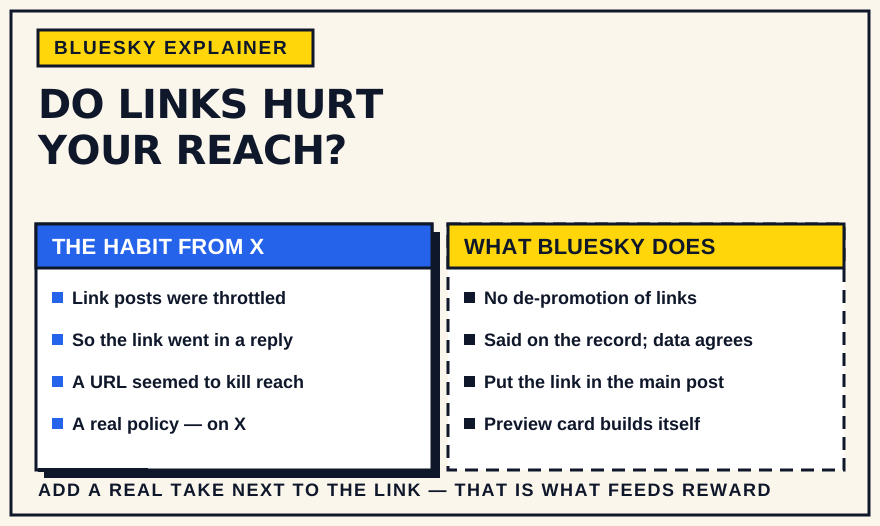
If you built a posting habit on X, you probably learned to treat links as a liability: add a URL to a post and the reach seems to vanish, so you move the link into a reply instead. That reflex was a response to a real policy. The question for anyone posting on Bluesky is whether the same rule applies here. The short answer is no. Bluesky has said on the record that it does not de-promote posts that contain links, and independent traffic data is consistent with that. Here is what is confirmed, what is reasonable inference, and how to share a link so it has the best chance of being seen.
The short answer
Adding a link to a Bluesky post does not trigger an automatic cut to your reach. There is no known platform-wide penalty for outbound links and no documented mechanism that pushes link posts down a feed. How far a post travels still depends on the usual factors — who follows you, when you post, and whether people reply, repost, or like it — but the URL itself is not held against you.
What Bluesky has actually said
In March 2025, Bluesky rolled out referral tracking for publishers: a shared link briefly passes through a short go.bsky.app redirect so newsrooms can measure the website traffic their posts produce. In TechCrunch's coverage of that launch, Bluesky COO Rose Wang put the company's position bluntly — “unlike other platforms, we don't de-promote your links.” A Bluesky representative had made the same point months earlier: “We want Bluesky to be a great home for journalists, publishers, and creators. Unlike other platforms, we don't de-promote your links.”
This is a statement of policy from the company, not an independent audit of Bluesky's ranking code. But it is on the record, it has been repeated, and Bluesky has not walked it back. Being link-friendly is central to how the platform pitches itself to writers and publishers, with its COO describing Bluesky as a “lobby” for discovering the rest of the web.
Why the fear followed people from X
The worry is not irrational. In November 2024, replying to a complaint about the “deprioritization of tweets with links,” Elon Musk offered a workaround: “Just write a description in the main post and put the link in the reply. This just stops lazy linking.” The stated aim, widely reported at the time, was to keep users on X rather than send them to outside sites. Facebook and other networks have long been described as doing something similar. Many people adapted by hiding links in replies, posting screenshots, or pointing to a “link in bio.”
X has since said it no longer applies a dedicated penalty to posts with links, though independent analysis disputes how much has actually changed. Either way, the habit outlived the policy, and plenty of people carried it straight to Bluesky.
What the outside data shows
Independent reporting on referral traffic is consistent with Bluesky's claim:
- The Boston Globe said traffic from Bluesky was already about three times its traffic from Threads, with roughly four and a half times the conversions to paying subscribers — despite Bluesky's much smaller audience.
- Guardian Australia reported Bluesky referral traffic at more than double its Threads traffic, and ahead of X.
- Similarweb figures cited by TechCrunch put Bluesky's outgoing visits in November 2024 at 38.6 million, against 24.5 million from Threads — from a far smaller user base.
- Smaller outlets have reported the same pattern at their own scale: more clicks from a few thousand engaged Bluesky followers than from a much larger X following.
None of this proves a negative — you cannot observe the absence of a penalty directly. But if Bluesky were quietly suppressing link posts, this pattern of outsized referral traffic would be hard to explain.
What about the preview card?
When you paste a URL, Bluesky attaches a link card showing the page's headline, image, and site name. You can keep that card or remove it and rely on your own text. The card is not a reach penalty — it is the same unit publishers use to earn the referral numbers above. Removing it is mostly a style choice: some people drop it when the thumbnail adds nothing, or when they would rather the post lead with their own words. If you keep it, still write a real post above it instead of letting the card carry the message.
Where the myth still has a grain of truth
A few things are worth separating from the myth, because they can still affect how far a link post spreads. These reflect general platform behaviour and inference, not stated Bluesky policy:
- Engagement-ranked feeds still rank by engagement. Your chronological Following feed shows every post from accounts you follow, link or not. But the Discover feed and many custom feeds weigh replies, reposts, and likes. A bare link with no comment tends to collect fewer of those, so it can spread less — not because it contains a link, but because it gave people little reason to react.
- A link with no context underperforms a link with a point of view. Posts that add a real take, a pull quote, or a question next to the link generally draw more replies than a headline and URL alone.
- Imported habits can cost you. Burying the link in a reply on Bluesky splits attention across two posts for no benefit, since the original post was never going to be penalised in the first place.
How to share links on Bluesky
- Put the link in the main post. There is no reason to hide it. Bluesky usually builds the preview card automatically.
- Add something only you would say. Lead with your angle or a specific detail, then include the link. Treat the URL as supporting material, not the whole post.
- Invite a response. A short question or a clear opening to disagree gives the engagement-ranked feeds something to work with.
- Post when your audience is active. Timing affects a link post like any other post, so planning ahead and scheduling your posts makes it easier to land in active windows.
- Keep a steady rhythm. One link post a week that people actually engage with beats a daily run of URLs. A repeatable posting workflow helps you stay consistent without doing it all by hand.
- Watch your own results. The go.bsky.app redirect makes it easier to see which posts drive clicks. Track which framings work and reuse them, the way you would when planning a content calendar.
The bottom line
The belief that links hurt your reach is a habit imported from a platform where it was true. On Bluesky, the company has said plainly that it does not de-promote links, and the referral data from publishers is consistent with that. What still decides how far a post goes is everything around the link: a post that offers a genuine thought and invites a reply travels further than a naked URL. Share the link, keep it in the post, and give people a reason to care about it.