 SkyyCast
You take a sharp photo, upload it, and on the feed it looks soft — smeared detail, muddy shadows, banding in a clear sky. The version on your phone is fine. What changed is that every mainstream social platform re-encodes images you upload, compressing them to keep pages light. Some quality loss is built in. The blur you can actually do something about comes from a handful of avoidable mistakes that stack on top of it.
The unavoidable part: recompression
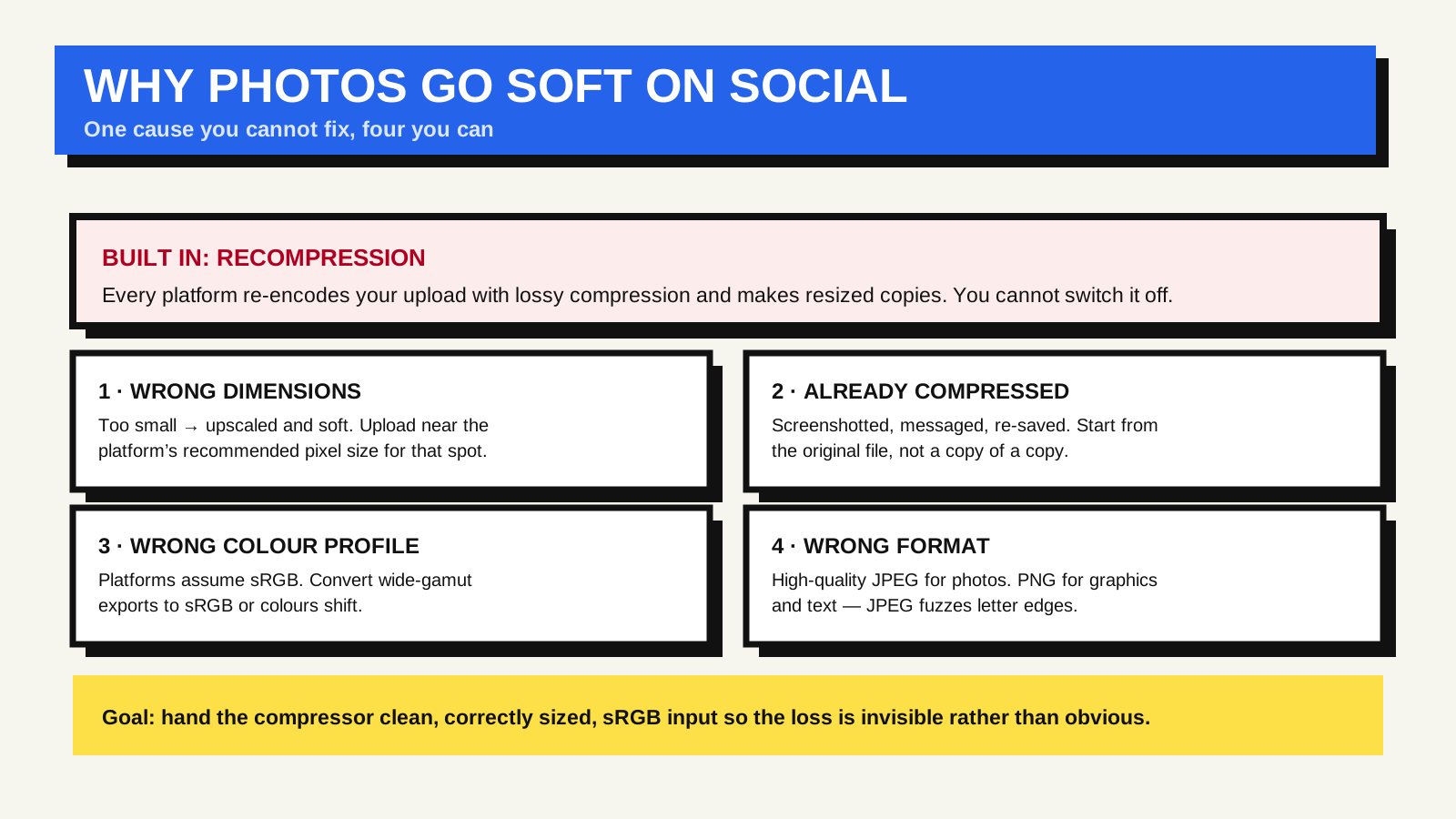
When you upload a photo, the platform does not keep your file as-is. It re-encodes it, almost always with lossy compression, and usually generates several resized copies for different screens. This is a deliberate trade-off: at their scale, smaller images mean faster feeds and far lower bandwidth costs. You cannot switch it off. What you can do is hand the compressor the best possible starting point so the result still looks good.
The avoidable parts
Uploading the wrong dimensions. If your image is smaller than the space the platform displays it in, it gets scaled up and looks soft. If it is enormously larger, the platform’s downscaling can add its own artefacts. Uploading close to the dimensions each platform recommends for that placement gives the cleanest result. As a rough guide, a square feed photo around 1080 pixels wide, and a landscape link-preview image around 1200 by 630 pixels, are widely supported starting points; check the current help pages for the platform you are using.
Starting from an already-compressed file. Every time a JPEG is saved, it loses a little more detail. A photo that has been screenshotted, sent through a messaging app, downloaded, and re-saved has been through several rounds of compression before the platform ever touches it. Work from the original camera file or a high-quality export, not a copy of a copy.
The wrong colour profile. Screens and social platforms assume images are in the sRGB colour space. A photo edited in a wider space such as Adobe RGB or Display P3 and uploaded without conversion can come out dull, oversaturated, or colour-shifted, because the platform reads the numbers as sRGB. Exporting or converting to sRGB before upload avoids it.
The wrong format for the content. Photographs belong in a high-quality JPEG, or a modern format the platform accepts. Graphics, screenshots, logos, and anything with text or hard edges belong in PNG — a JPEG of text produces visible fuzz around the letters. MDN’s image file type and format guide and our comparison of web image formats both cover which format suits which kind of image.
A practical upload routine
- Edit from the original file, not a re-saved copy.
- Export to sRGB.
- Resize to roughly the platform’s recommended dimensions for that placement.
- Use a high-quality JPEG for photos, PNG for graphics and text.
- Upload over a stable connection — some apps quietly drop to a lower-quality upload on a weak signal.
Even done perfectly, the feed version will not be pixel-identical to your original. The goal is to make the platform’s compression start from clean, correctly sized, correctly coloured input, so the loss is invisible rather than obvious.
Common questions
Does posting a PNG keep photos sharper?
Not for photographs. Platforms usually re-encode a photographic PNG to a lossy format anyway, and the large upload can time out or be rejected. PNG helps for graphics and text, where lossless compression preserves the sharp edges.
Why does my link preview image look worse than my feed photos?
Link-preview images have their own dimension and aspect-ratio expectations, and platforms cache and re-crop them. See how link previews work for the tags and sizes involved.
Is there a “high quality uploads” setting?
Some apps expose one, more often for video than photos, and it mainly affects uploads over mobile data. It is worth enabling, but it does not remove server-side recompression.