 SkyyCast
There is a specific disappointment in SEO work: you craft a careful meta description, publish the page, search for it a week later, and Google has shown a completely different sentence pulled from the third paragraph. This happens often, and it is not a bug. Understanding why is the key to writing descriptions that actually get used.
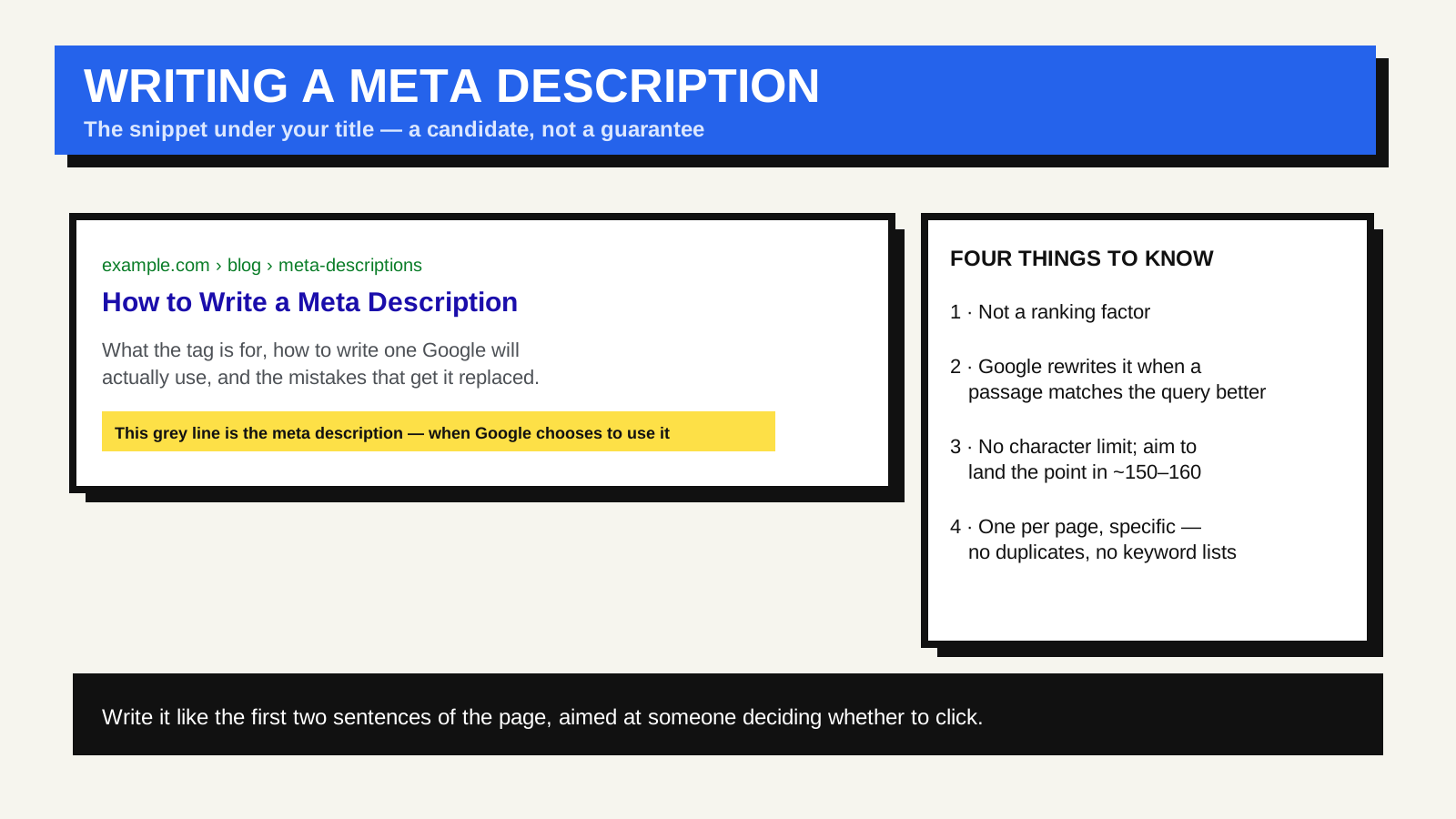
What a meta description is for
The meta description is a short HTML tag Google reads from the page’s head. Google may use its text as the snippet — the grey line beneath the blue title in search results. It is not shown on the page itself, it is not a ranking factor, and Google treats it as one candidate for the snippet rather than a guaranteed choice.
Google’s own guidance on snippets is explicit that they are drawn primarily from the page content, and that the meta description is used when it might describe the page more accurately than a passage taken from the body. In practice, Google keeps your description when it reads like a clean summary and matches the search; it rewrites when the description is generic, stuffed, duplicated across pages, or simply less relevant to that particular query than a sentence already on the page.
Writing one that survives
The reliable approach is to write the description as if it were the opening two sentences of the page, aimed at someone deciding whether to click.
- Summarise what the page delivers, in plain language. “A step-by-step guide to X, including Y and the mistake Z” beats “Everything you need to know about X.”
- Make it specific to this one page. If two pages could share a description, neither is specific enough, and Google is more likely to rewrite both.
- Front-load the useful part. The end may be truncated, so the payoff should not live in the last clause.
- Use the words people actually search, without stuffing. Matched terms are often bolded in the snippet, and writing naturally around the topic tends to produce those matches anyway.
Length: there is no character count
Google does not enforce a fixed limit; it truncates the snippet to fit the device, so the visible length varies. As a working target, keeping the core message inside roughly the first 150 to 160 characters means it usually survives on desktop, with mobile showing a little less. Write for meaning first and trim second — a slightly long description that reads well beats a padded one hitting an exact number.
What not to do
- Duplicate descriptions across many pages. Leave the tag off entirely rather than repeat a boilerplate line; a Google-generated snippet per page is usually better than one generic sentence.
- Keyword lists. “meta description, meta tag, SEO description, how to write” is not a sentence, and it will be replaced.
- Promising something the page does not contain. A misleading snippet wins the click and loses the reader, which is worse than no click.
- Making it only a call to action. “Read our guide now!” tells the searcher nothing about whether the guide answers their question.
How it differs from the title and from structured data
Three separate things shape how your result looks. The title element is the headline and does carry weight for relevance. The meta description is the supporting sentence and does not. Structured data is a machine-readable summary that can add elements such as a date or author to the result, and is separate again. On social platforms, the equivalent of the description is handled by Open Graph tags. Set each of them deliberately and independently.
Common questions
Does a good meta description improve rankings?
Not directly. It can improve click-through from the results page, and a page that consistently earns clicks and satisfies readers tends to do well over time, but the tag itself is not a ranking signal.
Should every page have one?
Write custom descriptions for the pages that matter most — key landing pages, cornerstone articles, anything you actively promote. For large sets of similar pages, a good template or a Google-generated snippet is usually fine.
Why does Google ignore mine even though it is well written?
Usually because a passage in the body matches that specific query better, and different searches for the same page can produce different snippets. If it happens for your main target query, tighten the description so it answers that query directly.