 SkyyCast
Lists, starter packs, and custom feeds all involve grouping accounts, which is why people mix them up. But they solve different problems: one organises your own reading, one recommends people to others, and one pulls posts from across the network by rule. None of them is the “main” feature — they are three tools for three jobs. Here is what each does, where they overlap, and which to reach for.
The one-line version
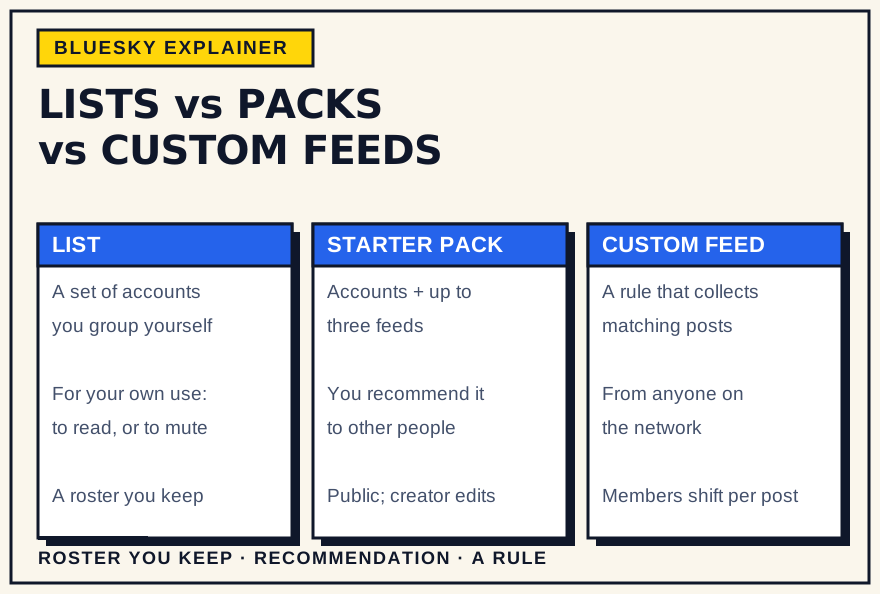
- A list is a set of accounts you group — for your own use, to read or to mute.
- A starter pack is a set of accounts, plus up to three feeds, that you recommend to other people.
- A custom feed is a rule that collects posts from anyone on the network who matches it.
Two quick tells: if the thing lives on your profile for other people to use, it is a starter pack; if it produces a scrolling timeline, it is a list or a feed — a list when the accounts are fixed, a feed when they are not.
Lists
A list is a collection of accounts you build, and it works in two modes. A curation list, once pinned, gives you a chronological timeline of just those accounts as its own tab, without their posts crowding your main Following feed — a clean way to keep up with a specific beat or a set of people you would rather not follow outright. Pinning a list does not follow those accounts, so it also lets you watch competitors or a conference crowd without changing who your profile says you follow. A moderation list is the opposite: you subscribe to it to mute or block everyone on it at once, and when the owner adds someone, they are muted or blocked for you automatically.
Lists are public by default and searchable in the app, and you can add someone to one straight from their profile. Because anyone can subscribe, one person maintaining a good blocklist protects everyone who subscribes to it — much of Bluesky's community moderation runs this way.
One limit worth knowing: a pinned list only ever shows the accounts you put in it. It will never surface someone new. For discovery, you need a feed.
Starter packs
A starter pack is a curated recommendation: up to 150 accounts and up to three custom feeds, bundled so someone can tap “Follow All” or adopt the whole set during sign-up. The creator controls it entirely — you cannot add yourself to someone else's — and packs are shared by link or QR code rather than found through in-app search. The job is onboarding: pointing a newcomer at the people and feeds worth following in a community.
A pack is a recommendation, not a reading tool. It does not give you an ongoing timeline of its members; it sits on your profile as a shareable object, and it works best when the people in it share it too.
Custom feeds
A custom feed is a running rule, not a fixed set of people. A small service — a feed generator — decides which posts appear, using keywords, a list, engagement thresholds, an algorithm, or a mix. It pulls from anyone on the network who matches, updates continuously, and anyone can subscribe. Feeds can be built with code or with no-code tools, and Bluesky's Attie can now assemble one from a plain-language description.
Two caveats. A feed's membership changes with every post that matches its rule, so it is never a stable group. And because a feed is a live service, it depends on whoever runs it staying online — if that service goes down, subscribers see an error instead of posts.
Where they overlap
The confusion is not unfounded; the three genuinely connect. A starter pack is backed by a list under the hood. You can convert a pack into a list with third-party tools to read the group's posts without following every account. A feed can be built on top of a list. And there is a long-standing proposal to merge lists and starter packs — unshipped as of 2026 — precisely because they overlap so much.
Underneath, a starter pack even generates a hidden list to hold its accounts, which is what makes pack-to-list conversion possible in the first place.
Common mix-ups
- Building a starter pack to read a group. A pack has no timeline. If you want to follow the group's posts, use a pinned curation list.
- Expecting a pinned list to widen your reach. It only shows the accounts you added. Discovery needs a feed, or inclusion in someone else's pack.
- Treating a custom feed as a fixed group. Its membership shifts with every matching post; it is a rule, not a roster.
- Assuming a starter pack is private or member-editable. It is public, and only its creator can change it.
A worked example
Say you cover local politics. You would keep a pinned curation list of the officials, reporters, and agencies you monitor; publish a starter pack named for your city's politics watchers so newcomers can follow the same people; and subscribe to or build a keyword feed for your city plus terms like “council” and “zoning” to catch posts from accounts you have never heard of. Three tools, three jobs — and all of it slots into the routine you use to plan posts.
Which one to use
- Your own timeline of specific people: a curation list, pinned.
- Helping newcomers find your community: a starter pack.
- An always-on stream about a topic, from anyone: a custom feed.
- Muting or blocking a group, or sharing that: a moderation list.
- Getting other people to discover you: none of these directly — that comes from being included in other people's feeds and packs, which you influence through your profile and posting rather than by creating an object.
The bottom line
Keep the jobs straight and the choice is easy: lists organise your reading, starter packs recommend people to others, custom feeds collect posts by rule. Most active accounts use all three — a pinned list or two for daily reading, a pack for their community, and a couple of niche feeds — without any of them doing another's job.