 SkyyCast
The AT Protocol is the open system Bluesky is built on. For a developer it is a stack of specifications; for a creator, the headline is simpler: it is an attempt to make your identity, your posts, and your follower graph belong to you rather than to a single app. Some of that is real today. Some is still a stated goal. Knowing which is which will save you from both the hype and the dismissal — here is the creator's-eye view, without the engineering.
Bluesky is an app; the protocol is the layer beneath it
Bluesky the app runs on the AT Protocol, but it is not the whole thing. Other apps are built on the same layer — photo and video apps, a livestreaming service, blogging platforms, event and messaging tools — and because they share the protocol, they can read the same public data: your account, your posts, who you follow. If you follow two hundred illustrators on Bluesky, a protocol-native art app can surface those same two hundred without you re-adding anyone.
What it is meant to give you as a creator
- An identity you keep. Your account is anchored to a portable identifier, not to one company's user table. A custom domain handle sits on top of that, so “@you.com” is yours across any app on the protocol.
- An account you can move. You can migrate your account and its history from one hosting provider to another. If a host bans you or shuts down, the intent is that your identity and audience survive the move.
- One presence across apps. Because your follows and posts are public protocol data, another app can show you the same social graph you built on Bluesky rather than making you start over.
- Feeds instead of one algorithm. The protocol is built for many feed algorithms to coexist, so discovery is not gated by a single company's ranking. AI feed tools such as Attie use that same open data.
One more sign the foundation is meant to last: in early 2026 a formal internet-standards working group took up the protocol, starting a multi-year move from “Bluesky's implementation” toward an independent specification.
What is actually true today, and what is still a goal
It is worth being precise, because the gap between the vision and the current state is real:
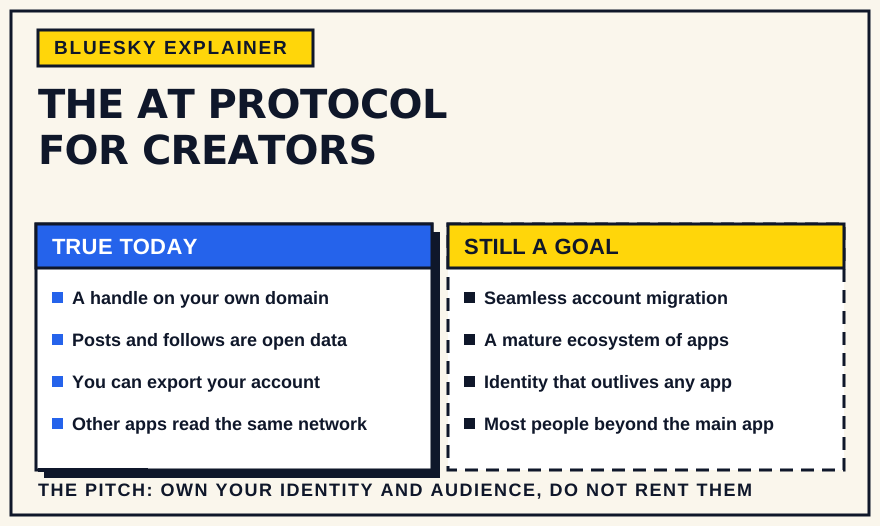
- Real: portable identity and a public graph. Your identifier and your follows exist at the protocol level now, which is why cross-app tools work at all.
- Real but technical: account migration. Moving your account between hosts is possible on the live network — away from Bluesky's infrastructure, between third-party hosts, and back. It is also a careful operation: part of the process signs away your previous host's ability to change your identity record, which is what makes a mistake hard to undo, and few people have needed to do it.
- Still a goal: “you can't be deplatformed.” In practice the large majority of accounts still sit on infrastructure Bluesky operates, and the identity system and main indexing layer are currently run by Bluesky too.
Bluesky and the protocol's maintainers do not hide this. The AT Protocol's own 2026 roadmap is largely about handing those central pieces — identity, relay, indexing — to independent operators over the next few years. The honest summary for now: more portable than a normal platform, not yet fully independent of one company.
Why a creator should care anyway
Even half-built, the protocol changes your risk. On a closed platform, a ban, an API change, or a company decision can erase an audience you spent years building. Here, your handle and your follower graph are not the app's property to delete — worst case, you move. Cross-app reach is a smaller but real benefit: you can publish long-form writing or photos on a protocol-native app tied to the same identity and audience as your short posts, instead of rebuilding a following on each service. And a niche you post about is not at the mercy of one feed's ranking — several feeds can carry it, and you can build one yourself.
What it does not change
The protocol does not distribute your work or grow your audience. It moves the plumbing; it does not write the posts. What earns followers is unchanged — a consistent posting habit, a profile that makes your topic obvious, and showing up in the feeds where your audience already reads. Rebuilding a content strategy around “decentralisation” is a mistake; treat the protocol as insurance, not a growth channel.
Practical takeaways
- Use a custom domain handle if you have a domain. It is the piece of portable identity you control most directly.
- Keep your own copy of your best work. Portable data is not a backup. Export or re-save the posts, threads, and images you would not want to lose.
- Try a protocol-native app if it fits your format, knowing your identity and graph come with you — a blog platform, a photo app, a video service.
- Do not run your own hosting server unless that is a project you actually want. It is not required to get the benefits above.
- Watch two things over the next year: whether account migration gets easier, and whether the identity and indexing layers move off Bluesky-operated infrastructure. That is the distance between the promise and the product.
Bottom line
The AT Protocol's pitch to creators is ownership of identity and audience instead of renting them from an app. Today it delivers a meaningful part of that and is open about the rest being unfinished. Let it make you less anxious about platform risk — and keep planning and posting as if the work is still the thing that matters, because it is.