 SkyyCast
AI-Assisted Development
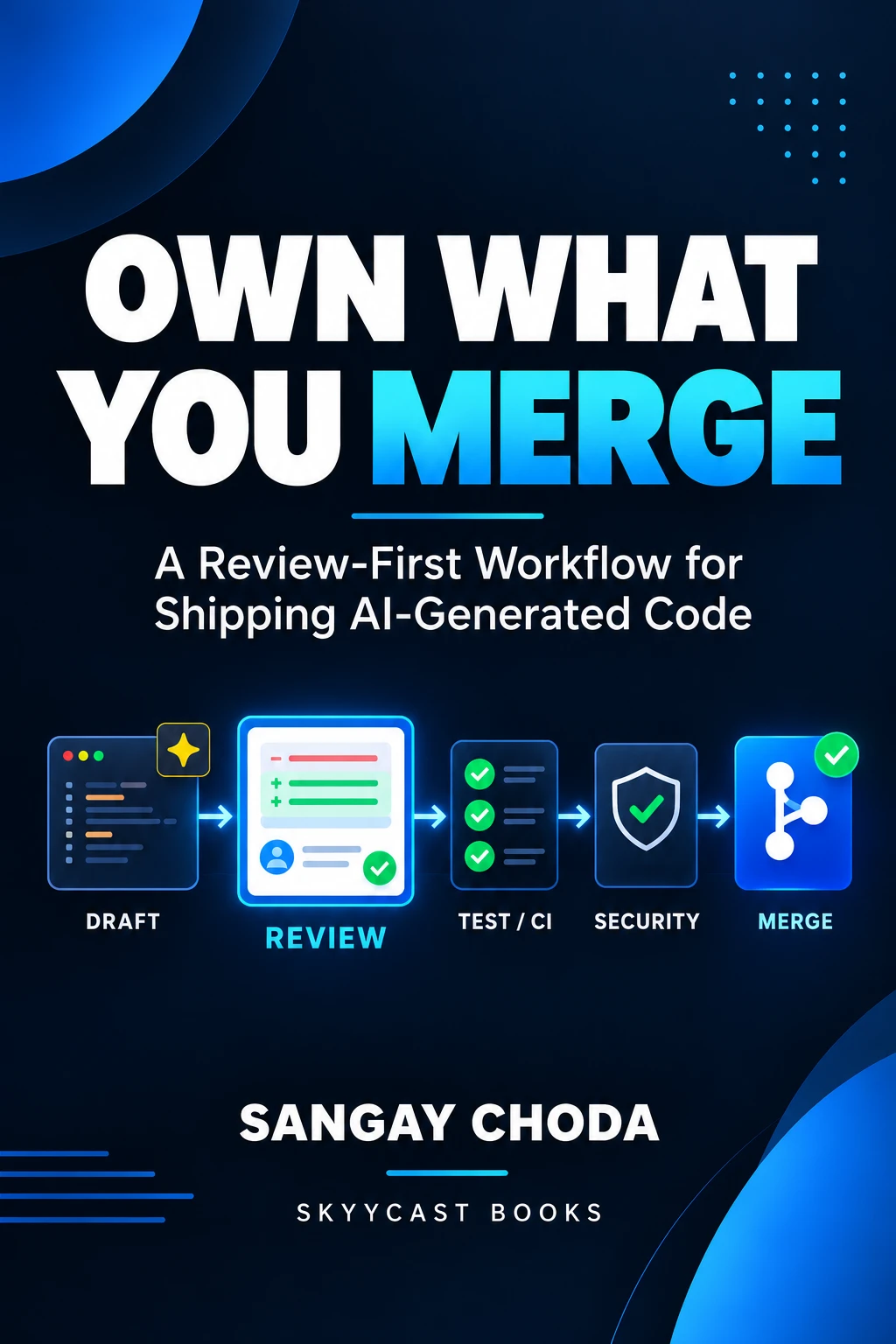
Own What You Merge
A Review-First Workflow for Shipping AI-Generated Code
A repeatable workflow to plan, test, review and own AI-generated code before you merge it. No productivity guarantee.
- Edition 1
- Node.js 24, TypeScript 6.0
$9.99 Regular price $24.00 58.4% off
Secure checkout by Paddle, our Merchant of Record. Sales tax or VAT is calculated at checkout. No SkyyCast account needed.
Already bought it? Download your copy.
Why this book
The problemAI tools write code fast, but the code is often almost right: it reads well, passes its own tests and is subtly wrong, and nobody is sure who answers for it once it is merged.
Who this book is for
This book is for professional developers who already use AI coding tools on real projects, and who have started to notice the cost: code that reads well and is subtly wrong, pull requests too large to review properly, tests that pass without proving much, and nobody quite sure who answers for a change once it's merged.
It's written for three kinds of reader:
- developers with a couple of years' experience or more, who can build and test software and want a disciplined way to work with generated code;
- solo builders, who have no second reviewer and need the workflow to stand in for one;
- small teams, of roughly two to ten people, who want consistent practice without an enterprise process.
It is not for:
- people learning to program: the book assumes you can read and write code comfortably;
- readers looking for prompt collections or tool tutorials: there are none here;
- no-code building;
- large-organisation governance programmes;
- engineers building AI models or agents.
The examples are in TypeScript on Node.js, but the workflow doesn't depend on the language. If you work in another language, the patterns, checklists and templates apply unchanged.
What this book promises, and what it doesn't
The book teaches one repeatable workflow for AI-assisted development:
Context → Tasks → Tests → Generate → Review → Security → Merge → Measure
Its promise is that you'll be able to review and own AI-generated code before you merge it: to know what a change does, to have checked it at the places where generated code tends to fail, and to name the person who answers for it.
It does not promise that you'll work faster. The published evidence on productivity is mixed and changing (Chapter 1), and the only honest answer for your own team comes from measuring your own work (Chapter 7).
- A written context file and task template your AI tools actually follow
- Tests approved before any code is generated, and protected from tampering
- A review order and a five-question security pass you can run on every AI-assisted change
- A named owner for every merged change, and a simple way to measure whether the workflow helps
What you'll get
- Full PDFAll 179 pages, ready to read on any device.
- EPUBReflowable edition for e-readers and phones.
- Sixteen diagrams
- Worked examples in a fictional teaching repository, Shelfmark
- An exercise with answers in every chapter
- A capstone that runs one feature through the whole workflow
- TemplatesAGENTS.md · Tool-specific instruction stub · Task breakdown · AI code-review checklist · Security review checklist · Pull request template · Team AI policy · Measurement worksheet · AI debugging workflow card · Change-risk triage card
- Sample codeTypeScript listings throughout, each run or type-checked at the pinned versions while the book was written
What you'll learn
- Recognise six ways plausible AI-generated code goes wrong
- Write repository context and size tasks for review, not generation
- Specify behaviour as tests before generating code, and review tests like code
- Review in an order that finds real problems: intent, tests, data flow, failure paths, structure
- Run a focused security pass on access control, input, dependencies, secrets and logs
- Write one-page team rules for one to ten people
- Measure your own experience honestly, with its limits stated
- Run a whole feature through the workflow, end to end
Who it's for
- Professional developers with about two years' experience or more who already use AI coding tools
- Solo builders who have no second reviewer
- Small teams of roughly two to ten people who want consistent practice
Before you start
- Comfortable reading and writing code; the examples are TypeScript on Node.js
- Some experience using an AI coding tool on a real project
Inside the book
Chapter 011. Why AI-Generated Code Is Almost Right5 sections
- 1.1The Almost-Right Problem
- 1.2What the Evidence Does and Doesn't Say
- 1.3Six Failure Patterns
- 1.4What Humans Still Decide
- 1.5The Review Gate: A Map of This Book
Chapter 022. Context and Task Breakdown5 sections
- 2.1What the Tool Doesn't Know
- 2.2Layers of Context
- 2.3Writing a Repository Context File
- 2.4Breaking Work into Reviewable Tasks
- 2.5Context Drift
Chapter 033. Test-First Generation5 sections
- 3.1When Tests Follow the Code
- 3.2Specifying Behaviour First
- 3.3Reviewing Tests Like Code
- 3.4Generating Against Approved Tests
- 3.5Edges, Boundaries and Negative Cases
Chapter 044. The Review-First Workflow6 sections
- 4.1Review When Code Is Cheap
- 4.2Shaping Pull Requests
- 4.3A Review Order That Finds Real Problems
- 4.4Explain-It-Back and Tracing
- 4.5Annotating a Review
- 4.6Fatigue and Rubber-Stamping
Chapter 055. Security and Ownership6 sections
- 5.1Generated Code Is Untrusted Input
- 5.2Authorization and Input Handling
- 5.3Dependencies You Didn't Choose
- 5.4Secrets, Logs and Data Exposure
- 5.5One Owner per Change
- 5.6The Security Pass in Practice
Chapter 066. Rules for Small Teams and Teams of One5 sections
- 6.1Why Write Rules at All
- 6.2The One-Page Policy
- 6.3Handoffs for AI-Assisted Work
- 6.4Keeping Rules Alive
- 6.5Rules for a Team of One
Chapter 077. Measuring Whether It Helps5 sections
- 7.1Feeling Faster Isn't Evidence
- 7.2A Few Honest Measures
- 7.3Setting a Baseline
- 7.4Running a Small Comparison
- 7.5Reading Results Without Fooling Yourself
Chapter 088. Capstone: One Feature, End to End9 sections
- 8.1The (Fictional) Shelfmark Repository
- 8.2Plan
- 8.3Context
- 8.4Tests First
- 8.5AI Implementation
- 8.6Human Review
- 8.7Security Review
- 8.8Fixes, Merge and Ownership
- 8.9Measurement and Retrospective
Chapter 09Appendices4 sections
- 9.1A. Templates (ten, printed in full)
- 9.2B. Tool notes (dated)
- 9.3C. Glossary
- 9.4D. References
Read a preview
9 curated pages from the book. Open any page to read it full size and turn the pages.
Book details
- Author
- Sangay Choda
- Publisher
- SkyyCast Books
- Pages
- 179
- Formats
- PDF + EPUB
- Language
- English
- Edition
- Edition 1
- Published
- Technology
- Node.js 24, TypeScript 6.0
- Compatible with
- Node.js 24 LTS, TypeScript 6.0.3, Fastify 5.12, Vitest 5.0
- Category
- AI-Assisted Development
About the author
FAQ
Which AI coding tools does it cover?
The workflow is tool-neutral. Appendix B has short, dated notes on how Claude Code, Cursor, GitHub Copilot, Codex and Gemini CLI find repository instructions, checked in September 2026.
Do I need a team?
No. Every chapter works for a solo developer, and Chapter 6 has a section on rules for a team of one.
Is it for beginners?
No. It assumes you can read and write code comfortably and already use an AI coding tool on real work.
Will it make me faster?
The book makes no speed promise. The published evidence is mixed, and Chapter 7 shows how to measure your own experience honestly.
Refunds
Paddle processes every purchase as our Merchant of Record, so refund requests go through Paddle. See our Refund Policy for how to ask. If a refund is issued, the download links for that order stop working.